What the Lid Is Really Doing When You Bake Bread in a Dutch Oven
A heavy lidded pot traps steam, stores heat and gives a home loaf the crackling crust and open crumb of a bakery oven. Here is the science, our exact timings, and the mistakes we see most.

Marisol Vega, Test Kitchen Director
· 5 min read
Every few weeks someone in our community asks why their bread tastes good but looks pale and squat, while the loaves they bake in a lidded pot come out tall and blistered. The dough is the same. The difference is almost entirely what happens in the first twenty minutes of baking, and a heavy pot with a lid happens to control those minutes very well.
Steam is the whole trick
When a shaped loaf goes into a hot oven, the outside starts to set immediately. If the surface dries and hardens too early, it acts like a shell and stops the loaf from expanding. Professional deck ovens inject steam for this reason. Moisture condenses on the cool dough, keeps the skin soft and stretchy, and lets gases inside the loaf push it upward. Bakers call that rise oven spring.
A home oven vents steam almost as fast as you create it. A covered pot solves this with no equipment at all. The dough itself releases water as it heats, and the lid keeps that water in a small space right against the crust. In our tests, loaves baked covered for the first 20 minutes rose about a third taller than identical loaves baked on an open stone.
Heat storage does the rest
Cast iron is slow to heat and slow to cool. Once it is fully preheated, the base and walls pour heat into the dough from every direction, which is why pot-baked loaves develop a deep, even bottom crust instead of a pale underside. Enameled and bare cast iron both work. What matters is mass and a lid that fits snugly.
- Preheat the pot with the lid on for a full 45 minutes at 475 F. Twenty minutes is not enough for the iron to catch up with the oven.
- Use a pot between 4 and 6 quarts for a loaf made with 500 grams of flour. Too wide and the dough spreads; too narrow and it sticks to the walls.
- Check that the lid knob is rated for high heat. Some plastic knobs are not, and a metal replacement is inexpensive.
- Place the pot on a middle rack so the top of the lid is not too close to the upper element.
Our timings, step by step
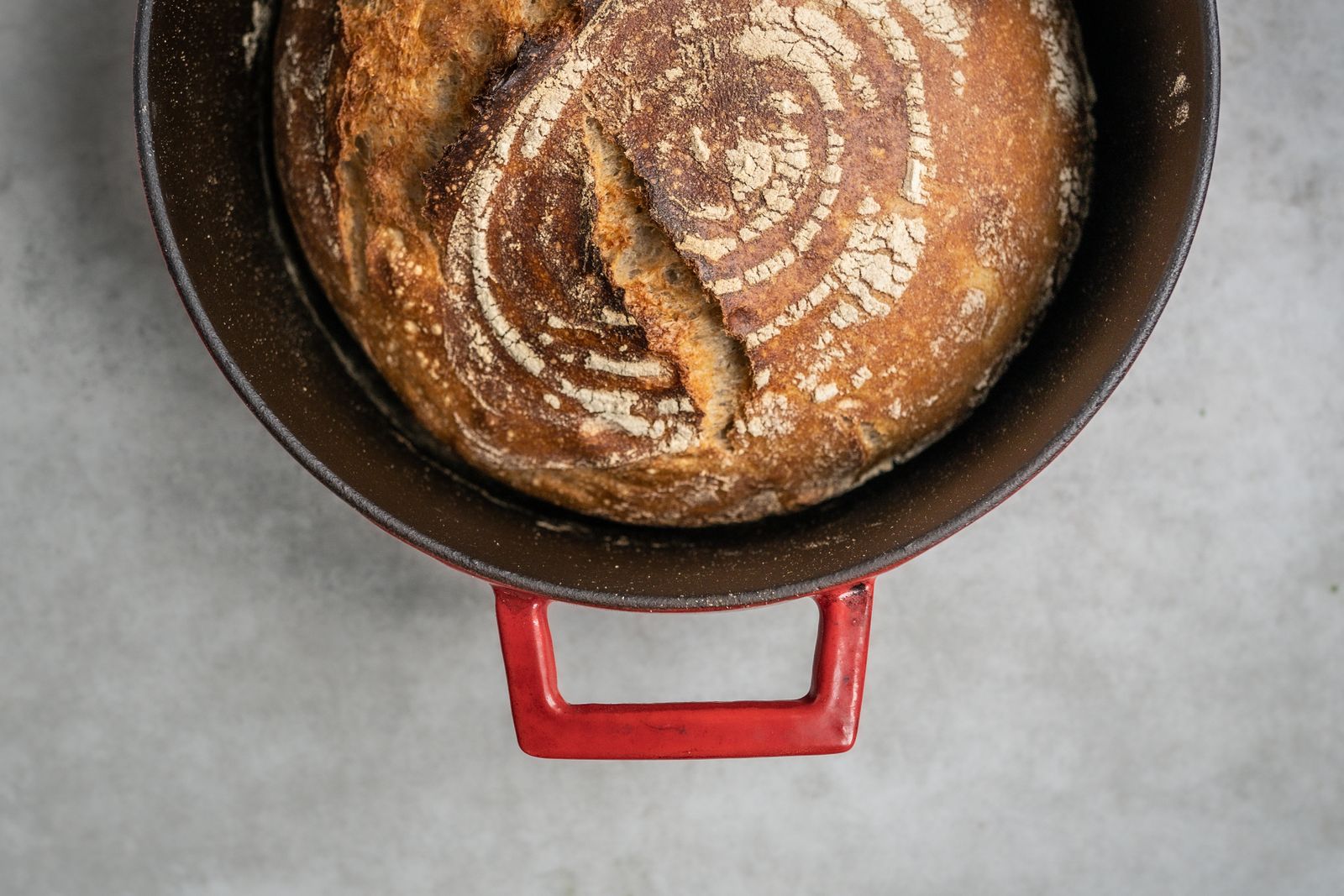
For a standard loaf of 500 grams flour at around 75 percent hydration, this is the schedule we use in the test kitchen. Turn the shaped dough out onto a square of parchment, score it with a single confident cut or a pattern like the spiral in the photo, and use the parchment as a sling to lower it into the hot pot. Cover immediately.
- Bake covered for 20 minutes at 475 F. This is the steam phase, when the loaf rises and the scoring opens up.
- Remove the lid and reduce the oven to 450 F. The surface is now set, and you want dry heat to brown it.
- Bake uncovered for another 20 to 25 minutes, until the crust is a deep chestnut color, darker than you think.
- Check that the internal temperature reads between 205 and 210 F, or tap the base and listen for a hollow sound.
- Cool on a rack for at least one hour before slicing, because the crumb is still setting as steam escapes.
Pale bread is underbaked bread. The flavor lives in the crust, so bake until it looks almost too dark, then give it five more minutes.
Scoring and flour for a clean pattern
A decorative score like a spiral or wheat stalk needs a contrast layer to show up. Just before scoring, dust the top of the loaf lightly with rice flour or all-purpose flour through a small sieve. Rice flour stays whiter because it browns less. Make one deep main cut, about half an inch, at a shallow angle so the loaf has a clear place to open. Decorative cuts should be shallow, barely through the skin, or they will tear the surface apart.
Mistakes we see most often
Most problems with pot-baked bread come from a few habits. Lowering dough into the pot with bare hands is the fastest way to a burn, so always use parchment. Removing the lid too early lets the crust harden before the loaf finishes rising. Leaving the lid on too long gives a soft, leathery crust. And slicing a hot loaf lets steam rush out, leaving a gummy center that people mistake for underbaking.
One more tip from our weekend baking classes: if the bottom of your loaf burns before the top browns, slide a sheet pan onto the rack directly below the pot for the uncovered phase. It shields the base from the lower element without changing anything else. Once you have the rhythm down, the pot becomes the most reliable piece of baking equipment you own.